
OLT Stick Configuration
On the [Devices] view, click on the OLT device identifier that needs to be configured to enter the device overview.

Users can view the basic information of this OLT on this view.
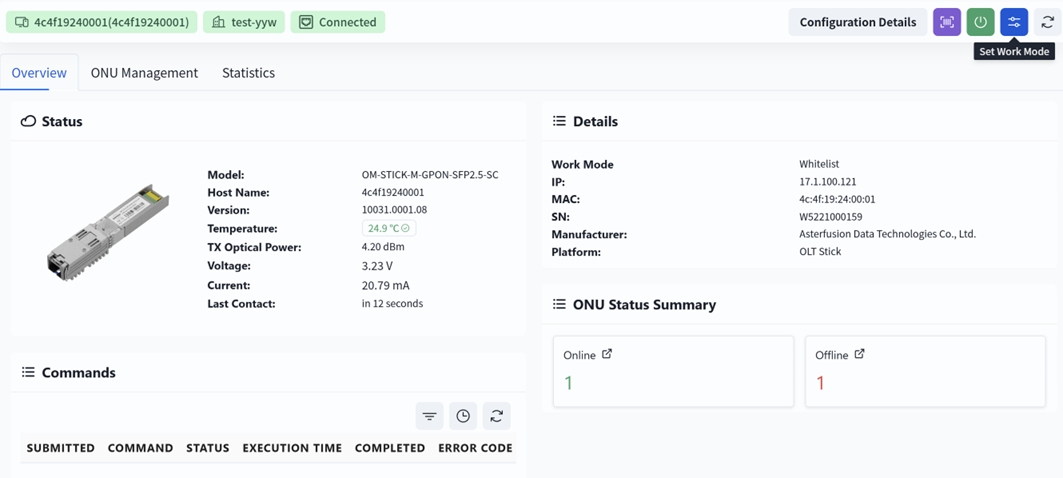
Work Mode
Section titled “Work Mode”Click on the [Set Work Mode] button at the top right corner.
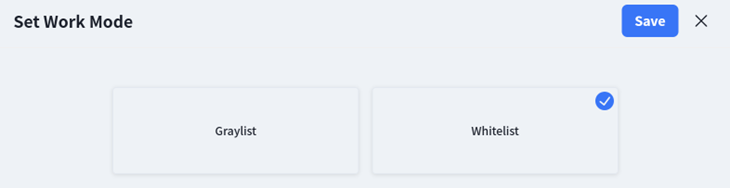
Graylist: In this working mode, the OLT Stick allows all ONUs to access by default and does not impose access restrictions.
Whitelist: In this working mode, access restrictions on ONUs are supported.
Configure
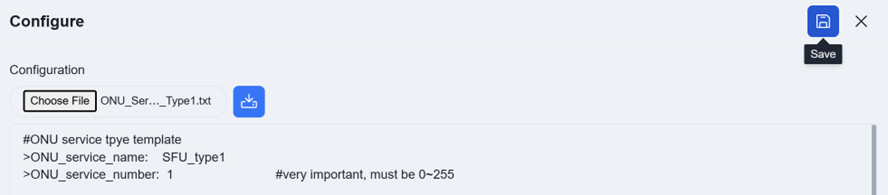
Section titled “Configure”Click on the [Configure] at the top right corner – [Choose File] to issue the configuration for the OLT Stick.


The format of the configuration file content is as follows:
#ONU service tpye template>ONU_service_name:    SFU_type1>ONU_service_number:  1                             #very important, must be 0~255
<flow 1 start>                      //example for VOIP  >max_BD    10             //uint16_t, max bandwith , Unit 20Kbit/s   ---10*20 =200K  >fix_BD     4             //uint16_t, fixed bandwith , Unit 20Kbit/s   ----80K  >ass_BD     4             //uint16_t, assure bandwith  ,Unit 20Kbit/s   ----80k  >type       3             //uint8_t, service type  >priority   7             //uint8_t, priority, 0~7,  0: top priority              ---7  >weight    100            //uint8_t, range, 1~255, 255: top priority          --- 100  >valid      0             //uint8_t, enable the flow: 1; disable the flow: 0      ---0  >vlan1_id   0             //uint16_t, pptep1  VLAN(TCI), 0: no vlan is required  >vlan2_id   0             //uint16_t, pptep2  VLAN(TCI),  >vlan3_id   0             //uint16_t, pptep3  VLAN(TCI),  >vlan4_id   0             //uint16_t, pptep4  VLAN(TCI),  >vlan5_id   0             //uint16_t, pptep5  VLAN(TCI),   ---- priority = 7, vlan =103<end>
<flow 2 start>                     // for muticast  >max_BD    5000          //uint16_t, max bandwith , Unit 20Kbit/s   ---5000*20 =100M  >fix_BD     150          //uint16_t, fixed bandwith , Unit 20Kbit/s    --150*20 = 3M  >ass_BD     150          //uint16_t, assure bandwith  ,Unit 20Kbit/s     --150*20 = 3M  >type        3           //uint8_t, service type  >priority    1           //uint8_t, priority, 0~7,  0: top priority              ---1  >weight      1           //uint8_t, range, 1~255, 255: top priority          --- 1  >valid       1           //uint8_t, enable the flow: 1; disable the flow: 0      ---0  >vlan1_id   102          //uint16_t, pptep1  VLAN(TCI), 0: no vlan is required     --- priority = 0, vlan =101  >vlan2_id   0            //uint16_t, pptep2  VLAN(TCI),  >vlan3_id   0            //uint16_t, pptep3  VLAN(TCI),  >vlan4_id   0            //uint16_t, pptep4  VLAN(TCI),  >vlan5_id   0            //uint16_t, pptep5  VLAN(TCI),<end>
<flow 3 start>                    //reserved  >max_BD    5000          //uint16_t, max bandwith , Unit 20Kbit/s   ---5000*20 =100M  >fix_BD     150          //uint16_t, fixed bandwith , Unit 20Kbit/s    --150*20 = 3M  >ass_BD     150          //uint16_t, assure bandwith  ,Unit 20Kbit/s     --150*20 = 3M  >type        3           //uint8_t, service type  >priority    1           //uint8_t, priority, 0~7,  0: top priority              ---1  >weight      1           //uint8_t, range, 1~255, 255: top priority          --- 1  >valid       0           //uint8_t, enable the flow: 1; disable the flow: 0      ---0  >vlan1_id    0           //uint16_t, pptep1  VLAN(TCI), 0: no vlan is required     --- priority = 0, vlan =101  >vlan2_id   0            //uint16_t, pptep2  VLAN(TCI),  >vlan3_id   0            //uint16_t, pptep3  VLAN(TCI),  >vlan4_id   0            //uint16_t, pptep4  VLAN(TCI),  >vlan5_id   0            //uint16_t, pptep5  VLAN(TCI),<end>
<flow 4 start>                    //reserved  >max_BD    5000          //uint16_t, max bandwith , Unit 20Kbit/s   ---5000*20 =100M  >fix_BD     150          //uint16_t, fixed bandwith , Unit 20Kbit/s    --150*20 = 3M  >ass_BD     150          //uint16_t, assure bandwith  ,Unit 20Kbit/s     --150*20 = 3M  >type        3           //uint8_t, service type 1~5  >priority    1           //uint8_t, priority, 0~7,  0: top priority              ---1  >weight      1           //uint8_t, range, 1~255, 255: top weight          --- 1  >valid       0           //uint8_t, enable the flow: 1; disable the flow: 0      ---0  >vlan1_id   101          //uint16_t, pptep1  VLAN(TCI), 0: no vlan is required     --- priority = 0, vlan =101  >vlan2_id    0           //uint16_t, pptep2  VLAN(TCI),  >vlan3_id    0           //uint16_t, pptep3  VLAN(TCI),  >vlan4_id    0           //uint16_t, pptep4  VLAN(TCI),  >vlan5_id    0           //uint16_t, pptep5  VLAN(TCI),<end>
<flow 5 start>                    //for internet  >max_BD    25000         //uint16_t, max bandwith , Unit 20Kbit/s   ---25000*20 =500M  >fix_BD     150          //uint16_t, fixed bandwith , Unit 20Kbit/s    --150*20 = 3M  >ass_BD     150          //uint16_t, assure bandwith  ,Unit 20Kbit/s     --150*20 = 3M  >type        3           //uint8_t, service type  >priority    1           //uint8_t, priority, 0~7,  0: top priority              ---1  >weight      1           //uint8_t, range, 1~255, 255: top priority          --- 1  >valid       1           //uint8_t, enable the flow: 1; disable the flow: 0      ---0  >vlan1_id    0           //uint16_t, pptep1  VLAN(TCI), 0: no vlan is required ,         - priority = 0, vlan =101  >vlan2_id    0           //uint16_t, pptep2  VLAN(TCI),  >vlan3_id    0           //uint16_t, pptep3  VLAN(TCI),  >vlan4_id    0           //uint16_t, pptep4  VLAN(TCI),  >vlan5_id    0           //uint16_t, pptep5  VLAN(TCI),<end>
#end of service type definition
After the upload is completed, click [Save], and the controller will automatically complete the configuration distribution.
Click on [Configuration Details], and users can see the current configuration of OLT Stick on the controller.

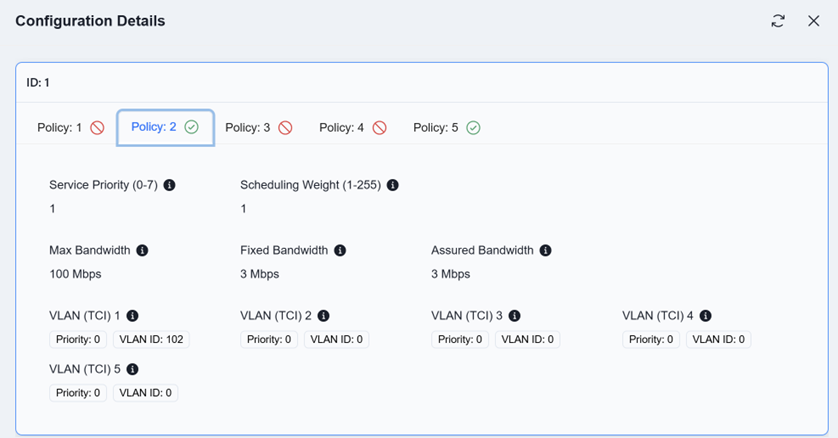
Policy: Each policy represents a type of business, with a maximum of 5 policies supported. The green suffix icon indicates that the policy is in use, while the red one indicates it is not.
Service Priority: The smaller the value, the higher the priority. Used to determine which service flow passes first during network congestion; high-priority services (e.g., Voice) take precedence over low-priority services (e.g., General Data).
Scheduling Weight: Used for Weighted Fair Queuing (WFQ) during bandwidth allocation. It determines the proportional relationship of bandwidth obtained by service flows under equal priority, enabling finer bandwidth allocation control.
Max Bandwidth: Defines the peak bandwidth limit usable by this service flow. Traffic exceeding this limit will be dropped or shaped. Used to prevent a single service from occupying too many network resources.
Fix Bandwidth: A constant bandwidth that is guaranteed to be allocated to this service flow regardless of whether the network is congested or not. Typically used for delay and jitter-sensitive services such as voice calls.
Assure Bandwidth: The minimum bandwidth guaranteed to be available for this service flow during network congestion. When the network is idle, bandwidth exceeding this value can be used. It is used to ensure basic service quality for critical operations.
VLAN(TCI): VLAN Tag Control Information. A 16-bit field encapsulating the complete 802.1Q VLAN tag information, including service priority and network segment identifier. This value is used to control Quality of Service (QoS) classification and packet forwarding within the Ethernet switching network.
ONU Management
Section titled “ONU Management”The controller supports users to manage ONUs through OLT Stick. Click [ONU Management], select the ONUs to be managed, click [Operation] in the upper right corner, and choose the management method.
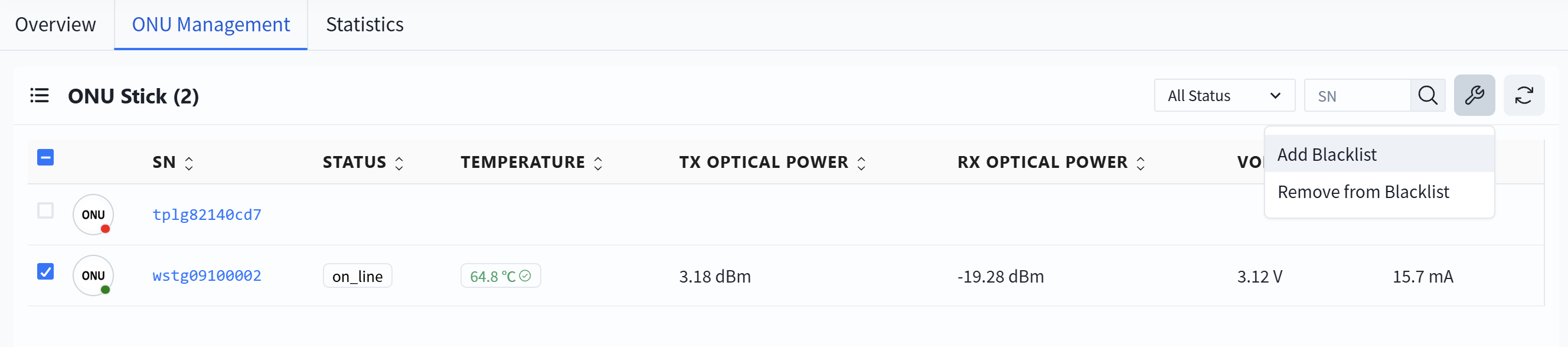
Add Blacklist: Immediately terminate the service forwarding of this ONU to prevent it from accessing the network.
Remove from Blacklist: Allow ONU to re-initiate the registration process and restore the data forwarding channel.