
Reflect-acl Configuration Guide
Introduction
Section titled “Introduction”Reflective ACL is a state-based dynamic access control technology primarily used for network security protection. Its core principle involves monitoring outbound sessions initiated from the internal network to automatically generate temporary reverse rules. These rules permit response traffic to return while blocking unauthorized access initiated from external sources.
Reflect-acl Configuration
Section titled “Reflect-acl Configuration”Create reflect-acl table
Section titled “Create reflect-acl table”| Operation | Command | Description |
|---|---|---|
| Enter the system configuration view | configure terminal | |
| Create and enter the system configuration view | access-list {REFLECT_L3|REFLECT_L3V6} string {ingress|egress} [des_crip string ] |
L3/L3v6 Matching Filter
Section titled “L3/L3v6 Matching Filter”| Keywords | Description |
|---|---|
| ip-protocol | IP protocol type, can be configured using either the numeric value or protocol name |
| src-ip | Source IP address (with subnet mask), e.g., “10.1.1.1/24” |
| dst-ip | Destination IP address (with subnet mask), e.g., “10.1.1.1/24” |
| src-port | Protocol source port number |
| dst-port | Protocol destination port number |
| dst-dns-group | DNS field, see Chapter 14 for details |
| geosite | Geosite field, see Chapter 15 for details |
| geoip | Geoip field, see Chapter 15 for details |
Example of Reflect-acl Configuration
Section titled “Example of Reflect-acl Configuration”Network Requirements
Interface 1 of the router connects to internal network users, while Interface 2 connects to the Internet. Configure a reflexive ACL on the outbound direction of Interface 2. Internal network hosts must first access servers on the Internet before Internet servers are permitted to access internal network hosts.
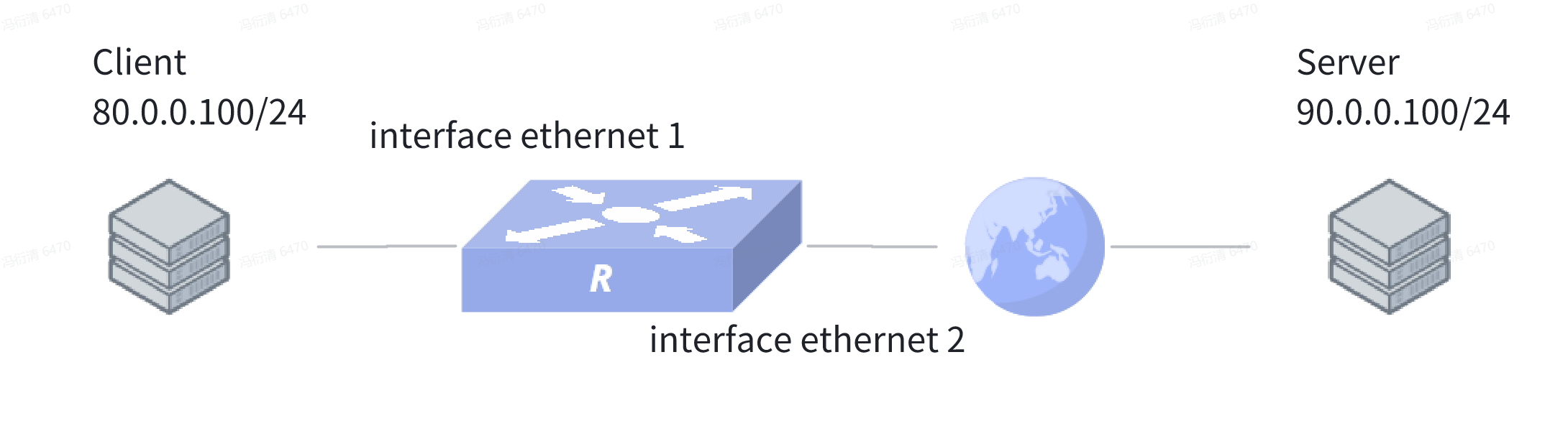
Procedure
sonic(config)# access-list REFLECT_L3 test egresssonic(config-REFLECT_L3-acl-test)# rule 1 src-ip 80.0.0.100 packet-action permitsonic(config-REFLECT_L3-acl-test)# exitsonic(config)# interface ethernet 2sonic(config-if-2)# acl test