
Loopback Detection Configuration
Introduction
Section titled “Introduction”Loopback Detection is a Layer 2 network protection mechanism used to promptly detect and handle loops in the network. Network loops can cause broadcast, multicast, and unknown unicast packets to be sent repeatedly, resulting in waste of network resources or even network paralysis. The loop detection function periodically sends detection packets through the interface and checks whether the packets return to the device, thereby determining whether there is a loop under the interface or VLAN. Once a loop is detected, the device will send an alarm, record logs, and process the interface according to user configurations (such as shutting down the interface), putting the interface into a controlled state to minimize the impact of the loop on the network.
Working Principle
Section titled “Working Principle”The implementation of loop detection is based on the following working mechanism:
On interfaces or VLANs with loop detection enabled, the device sends detection packets at fixed time intervals (configured via loopback-detection interval-time). The detection packets are sent in broadcast mode, with the destination MAC address being the broadcast address, the Ethernet type being 0x9998, and the packet payload containing the sending port name or VLAN information.
Loop detection supports two detection granularities:
- Interface-based detection: After enabling loop detection in the interface view, the device only sends detection packets from the interface itself and monitors whether it receives the packets it sent from the same interface. If received, it is determined that there is a loop in the network connected to this interface, and the configured action for the interface is triggered.
- VLAN-based detection: After enabling loop detection in the VLAN view, the device sends detection packets on all member interfaces within the VLAN and monitors whether any interface in the VLAN receives the packets it sent. As long as the packet is received by any interface in the VLAN (which can be a different port from the sending interface), it is determined that there is a loop in the VLAN, and the configured action for the interfaces in the VLAN is triggered.
After detecting a loop, the device immediately executes the configured processing action: by default, shutting down the interface (shutdown) or only recording a log (logging). After the interface is shut down, the device continuously monitors the loop status. If an automatic recovery time is configured (loopback-detection recovery-time), the device will attempt to recover the interface after this time; if the loop has been eliminated, the interface returns to its normal state; otherwise, it remains in a controlled state. Users can also manually recover the shut-down interface (via no shutdown or clear loopback-detection).
Configuration
Section titled “Configuration”| Operation | Description |
|---|---|
| Configure the sending cycle of detection messages | Optional (Global) |
| Configure the sending cycle of alarm logs | Optional (Global) |
| Enable the loop detection function of the interface/VLAN | Mandatory (Interface/VLAN) |
| Configure loop detection processing actions | Optional (Interface) |
| Configure the automatic recovery time of the interface | Optional (Interface) |
Configure the Sending Cycle of Detection Messages
Section titled “Configure the Sending Cycle of Detection Messages”Use this command to set the sending interval of loop detection packets. The smaller the interval, the higher the detection sensitivity, but the greater the system resource consumption.
| Operation | Command | Description |
|---|---|---|
| Enter the system configuration view | configure terminal | - |
| Configure the sending cycle | loopback-detection interval-time interva | interval: The value range is 10 to 300 seconds, with a default of 30 seconds. |
Configure the Sending Cycle of Alarm Logs
Section titled “Configure the Sending Cycle of Alarm Logs”This command sets the interval at which the system repeatedly prints alarm logs after an interface is shut down due to a loop. The default value of 0 means that repeated printing is not performed.
| Operation | Command | Description |
|---|---|---|
| Enter the system configuration view | configure terminal | - |
| Configure the log sending cycle | loopback-detection log-time interval | interval: The value range is 10–300 seconds, with a default of 0 seconds |
Enable the Loop Detection Function of the Interface/VLAN
Section titled “Enable the Loop Detection Function of the Interface/VLAN”When configured in the interface view, it only takes effect on the current interface and adopts an interface-based detection mechanism; when configured in the VLAN configuration view, it takes effect on all ports within the VLAN and adopts a VLAN-based detection mechanism.
| Operation | Command | Description |
|---|---|---|
| Enter the interface configuration view | interface ethernet interface-id | - |
| Enable interface loop detection | loopback-detection enable | - |
| Or enter the VLAN configuration view | vlan vlan-id | - |
| Enable VLAN loop detection | loopback-detection enable | - |
Configure Loop Detection Processing Actions
Section titled “Configure Loop Detection Processing Actions”The action that the device performs on the interface when a loop is detected.
| Operation | Command | Description |
|---|---|---|
| Enter the interface configuration view | interface ethernet interface-id | - |
| Configure action | loopback-detection action {logging | shutdown} | logging: Only record logs; |
| shutdown: Record logs and close the interface (default) |
Configure the Automatic Recovery Time of the Interface
Section titled “Configure the Automatic Recovery Time of the Interface”After the interface is shut down due to a loop, how long will it take to automatically attempt to return to the normal state? If the loop has disappeared after recovery, the interface will be re-enabled.
| Operation | Command | Description |
|---|---|---|
| Enter the interface configuration view | interface ethernet interface-id | - |
| Configuration recovery time | loopback-detection recovery-time interval | interval : The value range is 10 to 65535 seconds |
Display and Maintenance
Section titled “Display and Maintenance”| Operation | Command |
|---|---|
| Check the global, port/VLAN configurations for loop detection | show loopback-detection config |
| Check the loop detection status (interfaces that are shut down and the reasons) | show loopback-detection status |
| Check the errdown status of all interfaces | show interface errdown |
| Clear the loop detection information and re-enable all interfaces that have been shut down. | clear loopback-detection |
Configuration example
Section titled “Configuration example”Networking Requirements
There are multiple user VLANs under a certain switch. To prevent loops caused by users’ incorrect connections within VLAN 100, it is required to enable VLAN-based loop detection in VLAN 100. When a loop is detected, the port should be shut down, and the interface automatic recovery time should be set to 60 seconds. Meanwhile, configure interface-based loop detection for the individual port Ethernet47, with the action being only logging without shutting down the port. The global loop detection period is 10 seconds, and the interval for sending alarm logs is 10 seconds.
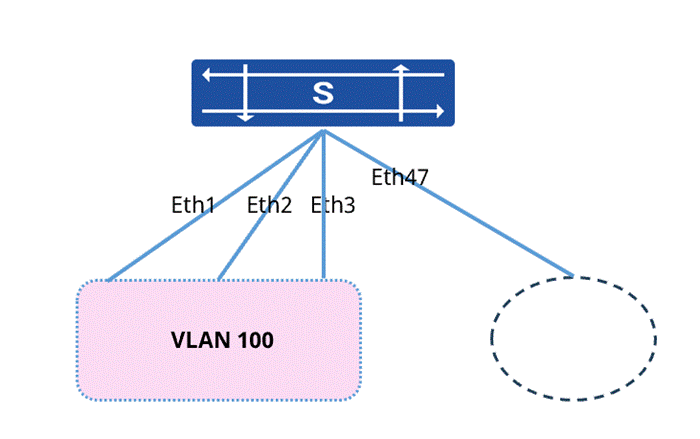
Configuration steps
1. Configure the global loop detection period
sonic(config)# loopback-detection interval-time 10sonic(config)# loopback-detection log-time 102. Enable loop detection in the VLAN view, add the interface to the VLAN in the interface view, and configure the loop detection action and the automatic recovery time of the interface.
sonic(config)# vlan 100sonic(config-vlan-100)# loopback-detection enablesonic(config-vlan-100)# exitsonic(config)# interface ethernet 1sonic(config-if-1)# switchport access vlan 100sonic(config-if-1)# loopback-detection action shutdownsonic(config-if-1)# loopback-detection recovery-time 60sonic(config)# interface ethernet 2sonic(config-if-2)# switchport access vlan 100sonic(config-if-2)# loopback-detection action shutdownsonic(config-if-2)# loopback-detection recovery-time 60sonic(config)# interface ethernet 3sonic(config-if-3)# switchport access vlan 100sonic(config-if-3)# loopback-detection action shutdownsonic(config-if-3)# loopback-detection recovery-time 603. Enable the Ethernet47 loop detection function and configure the loop detection action
sonic(config)# interface ethernet 47sonic(config-if-47)# loopback-detection enablesonic(config-if-47)# loopback-detection action logging4. Verification
View configuration information
sonic# show loopback-detection configpackets interval time: 10 (sec)log interval time: 10 (sec)
Port/Vlan                     Action             Recovery-Time               Status----------------------------------------------------------------------------------------------Ethernet1                    shutdown                 60Ethernet2                    shutdown                 60Ethernet3                    shutdown                 60Ethernet47                   logging                                          enableVlan100                                                                       enable
Check the loop detection status (if Vlan100 has a loop)
sonic# show loopback-detection statusYou can re-up err-down ports one by one by "no shutdown" under interface config, re-up all by "clear loopback-detection", or configure "loopback-detection recovery-time" for automatic recovery.
loopback is detectedPort                  Status         Caused By                Time----------------------------------------------------------------------Ethernet1             shutdown       Vlan100                  00:00:05Ethernet2             shutdown       Vlan100                  00:00:05Ethernet3             shutdown       Vlan100                  00:00:05